How to Verify Hearing Aid Factory Certifications (FDA, CE, ISO)

Table of Contents

In today’s competitive medical device market, sourcing reliable hearing aid manufacturers is more important than ever. Certifications like FDA, CE, and ISO are essential indicators of a manufacturer’s credibility, quality, and compliance with international standards.

For procurement managers, especially those buying in bulk or operating in regulated markets like the EU or North America, verifying these certifications is a critical part of the supplier selection process. In this article, we break down what each certification means, how to verify them effectively, and what red flags to avoid.

Why Certifications Matter in Hearing Aid Manufacturing

  • Product quality assurance
  • Legal compliance in target markets
  • User safety and satisfaction
  • Customs clearance and logistics
  • Brand reputation and liability protection

Understanding the Three Key Certifications

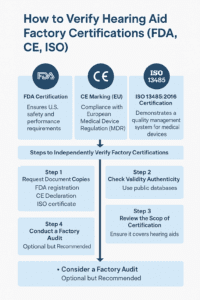
1. FDA Certification

What It Means: The FDA ensures that hearing aids sold in the U.S. meet specific safety and performance requirements.

How to Verify:

  • Visit the FDA database
  • Search by manufacturer’s name or product code

2. CE Marking (EU)

What It Means: A CE mark indicates compliance with EU Medical Device Regulation (MDR).

How to Verify:

  • Request the EC Declaration of Conformity
  • Check Notified Body number in the NANDO database

3. ISO 13485:2016 Certification

What It Means: Demonstrates a quality management system for medical devices, including hearing aids.

How to Verify:

Steps to Independently Verify Factory Certifications

  1. Request Document Copies: FDA registration, CE Declaration, ISO certificate
  2. Check Validity: Cross-check with public databases
  3. Review Scope: Ensure it covers hearing aid production
  4. Consider Factory Audit: Optional but highly recommended for bulk orders

Common Red Flags in Certification Documents

Red FlagWhat It MeansAction to Take
Generic product categoryNot certified specifically for hearing aidsRequest correct scope
Missing expiration dateCertificate may be outdated or invalidAsk for latest version
Unknown certifying bodyPossibly a fake or non-accredited issuerCheck IAF/NANDO
Supplier avoids document sharingLack of transparency or non-complianceReconsider supplier

How Goodmi Ensures Full Certification Transparency

At Goodmi Intelligent (Shenzhen) Co., Ltd., we provide:

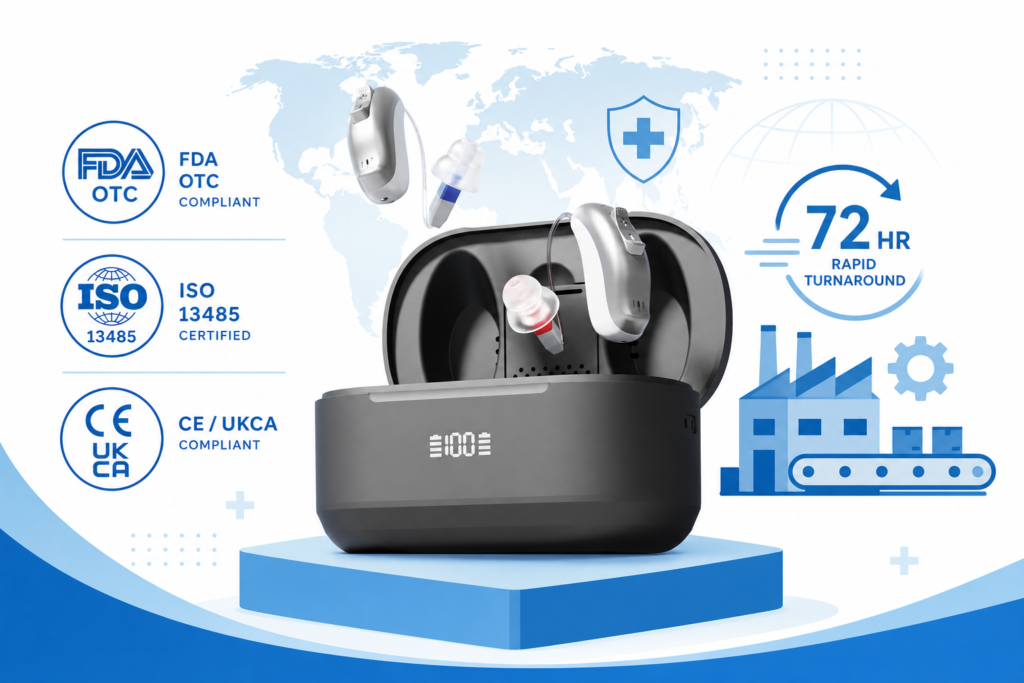
  • FDA-registered hearing aids
  • CE-compliant under MDR standards
  • ISO 13485:2016 certified production facility

All documents are available upon request, and we support third-party audits at our Shenzhen factory. As a trusted OEM/ODM partner, we help ensure your hearing aid supply chain is fully compliant.

Conclusion

Verifying FDA, CE, and ISO certifications should be part of every hearing aid procurement manager’s due diligence checklist. Doing so not only safeguards your reputation but ensures legal compliance and consistent quality for your markets.
Need help verifying your hearing aid supplier?
Contact Goodmi today or download our certification checklist to simplify your sourcing process.

Submit Your Sourcing Request
Related Posts
2026 Global Hearing Aid Market Trends: Why High-Performance RIC Models are Dominating the Wholesale Sector

2026 Global Hearing Aid Market Trends: Why High-Performance RIC Models are Dominating the Wholesale Sector As we move into 2026, the global hearing aid industry is witnessing its most significant transformation in a decade. Driven by an aging global population and rapid technological breakthroughs, the demand for sophisticated auditory solutions has shifted from simple sound amplification to intelligent, lifestyle-integrated systems. For wholesalers and distributors, understanding these trends is not just about staying relevant—it is about identifying the products that will define market growth for the next five years. Currently, one form factor stands above the rest: the RIC (Receiver-in-Canal) hearing aid. 1. The AI Integration Peak In 2026, AI is no longer a buzzword; it is a core functional requirement. High-performance RIC models are now equipped with neural processing units that can distinguish between human speech and background noise in real-time. For B2B buyers, this means offering products that provide higher user satisfaction and lower return rates. 2. The Unstoppable Rise of Rechargeable Technology The shift toward eco-friendly and user-convenient power sources has reached a tipping point. Wholesalers are reporting a clear preference for lithium-ion rechargeable models over traditional zinc-air battery units. Goodmi’s latest RIC series, for instance, offers up

Read More >>
How to Choose the Right OEM Hearing Aid Manufacturer in China

How to Choose the Right OEM Hearing Aid Manufacturer in China China has become one of the world’s leading manufacturing centers for hearing aids, supplying OEM and ODM solutions to distributors, retailers, healthcare providers, and private-label brands worldwide. However, selecting the right manufacturing partner requires much more than comparing prices. This guide explains the key evaluation criteria procurement managers should consider before choosing an OEM hearing aid manufacturer in China. Contents Why Source Hearing Aids from China? Verify Certifications & Compliance Evaluate Engineering & R&D Assess Manufacturing Capacity Review OEM & ODM Services Quality Control System Communication & Technical Support Supplier Evaluation Checklist Conclusion Why Source Hearing Aids from China? China has developed a mature hearing aid manufacturing ecosystem supported by advanced electronics supply chains, precision manufacturing, and continuous innovation in digital hearing technology. Many factories now produce Bluetooth hearing aids, rechargeable devices, AI-powered DSP hearing aids, and complete OEM/ODM solutions for international customers. Industry Insight A reliable OEM manufacturer can become a long-term strategic partner by providing product innovation, stable production capacity, and customized branding solutions—not simply low-cost manufacturing. 1. Verify Industry Certifications and Compliance Before selecting a supplier, verify internationally recognized certifications such as ISO 13485, CE, FDA-related

Read More >>
Why RIC Hearing Aids Will Dominate the Global Market in 2026

Why RIC Hearing Aids Will Dominate the Global Market in 2026 The global hearing aid market is entering a new era of innovation. As populations continue to age and consumers demand smarter, more comfortable hearing solutions, Receiver-in-Canal (RIC) hearing aids are rapidly becoming the preferred choice for both users and distributors. Contents Why the Hearing Aid Market Is Changing What Makes RIC Hearing Aids Different? 5 Reasons RIC Hearing Aids Will Lead the Market Emerging Technology Trends How Procurement Managers Should Evaluate Manufacturers Conclusion The Global Hearing Aid Market Is Evolving Population aging, increasing awareness of hearing health, and rapid advances in digital hearing technology are reshaping the industry. According to multiple healthcare studies, millions of first-time hearing aid users are expected to enter the market over the next five years. Unlike previous generations, today’s consumers expect hearing aids to function like smart wearable devices, offering Bluetooth connectivity, rechargeable batteries, smartphone control, and superior speech clarity. Market Insight The RIC segment is forecast to become one of the fastest-growing hearing aid categories worldwide thanks to its balance of comfort, aesthetics, and advanced performance. What Makes RIC Hearing Aids Different? Receiver-in-Canal hearing aids position the receiver directly inside the ear canal

Read More >>

We'd like to work with you

Send us a message if you have any questions or request a quote. Our experts will give you a reply within 24 hours and help you select the right hearing aid you want.

Get A Free Quote

All of our products are available for sampling