Top 3 Manufacturers of Hearing Aids in China

Table of Contents

China has emerged as a leading hub for hearing aid R&D, precision manufacturing, and global distribution. For procurement managers and distributors, selecting the right partner goes far beyond unit price—it requires evaluating production capacity, quality systems, certifications, and OEM/ODM readiness. This article reviews three manufacturers that consistently stand out for supply reliability, compliance, and product-market fit.

1) Goodmi Intelligent (shenzhen) Co., Ltd. — Innovation-Driven OEM/ODM Specialist

Company Profile

Goodmi Intelligent (shenzhen) Co., Ltd. focuses on Bluetooth-enabled OTC hearing aids alongside CIC、BTE、RIC lines, serving both retail and clinical channels. The company has gained an advantage through its fast customization cycle and high-quality products, and has already exported its products to over 50 countries around the world.

Core Strengths

  • OEM/ODM depth: Firmware presets, acoustic tuning, private-label packaging, multilingual manuals.
  • Production capacity: Scaled lines designed for rapid ramp-up during peak seasons.
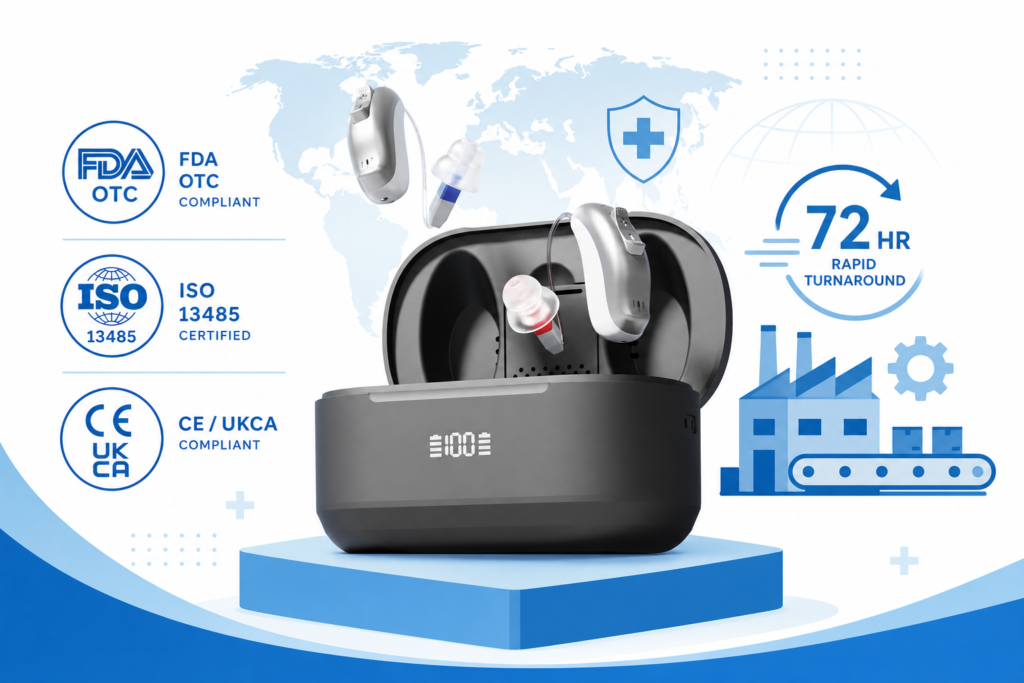
  • Compliance: ISO 13485 QMS, FDA,CE-marked products; documentation support for market entry.
  • Technology: Bluetooth 5.x connectivity, adaptive noise reduction, rechargeable platforms.

Best For

Suitable for buyers who are seeking products with high cost-effectiveness, diverse functions, competitive prices, and who have certain requirements regarding delivery time.
2) Beltone Technology (China) — Global Network, Local Strength

Company Profile

Beltone Technology (China) leverages international R&D with standardized production in China. The result is a stable portfolio that balances premium models with cost-effective digital devices for wider coverage.

Core Strengths

  • Reliable output: Consistent supply for institutional and retail buyers.
  • Broad portfolio: From advanced DSP models to value SKUs for price-sensitive segments.
  • Support: Retail training, merchandising kits, and after-sales resources.

Best For

Procurement teams prioritizing stability, governance, and cross-market credibility across medical and OTC channels.

3) Lisound Hearing — High-Volume Production at Competitive Pricing

Company Profile

Lisound Hearing is known for large-run manufacturing and export-ready documentation. The factory focuses on dependable, cost-efficient digital models that meet common compliance requirements.

Core Strengths

  • Economies of scale: High volumes enable aggressive pricing for bulk orders.
  • Certifications: ISO and CE pathways to simplify cross-border trade.
  • Range: From entry-level digitals to mid-tier feature sets across BTE、RIC、CIC.
  • Customization: Branding and accessory bundles; straightforward private label.

Best For

Distributors targeting price-sensitive markets requiring steady, high-volume supply with compliant documentation.

Comparative Snapshot for Buyers

ManufacturerKey StrengthsIdeal Use Case
Goodmi HearingBluetooth focus, OEM/ODM flexibility, competitive landed costBrand owners/distributors building tech-forward OTC lines
Beltone Technology (China)Global credibility, standardized quality, strong supportBuyers needing stability and multi-channel recognition
Lisound HearingHigh-volume capacity, sharp pricing, compliant exportsLarge procurement for price-sensitive geographies
Procurement checklist: request certificate numbers and test reports (ISO 13485, FDA, CE, RoHS), verify batch traceability, review QC flow (IQC–IPQC–FQC–OQC), and confirm after-sales policies/warranty terms before finalizing framework agreements.

Key Procurement Considerations Beyond Price

1) Certifications & Market Compliance

Confirm ISO 13485 certification for the factory and product-level CE documentation. For U.S. distribution, align with FDA requirements and labeling rules. Ensure RoHS/REACH where applicable. Goodmi has now obtained a series of certifications including UKCA, FDA, CE, RoHS, and ISO13485.

2) OEM/ODM Capability & Time-to-Market

Assess tooling lead time, firmware customization workflows, and packaging localization. Shorter prototype-to-pilot cycles reduce lost opportunity during seasonal demand spikes.

3) Supply Chain Resilience

Ask about second-source components, safety stock, and production line redundancy. Evaluate historical on-time delivery rates and surge capacity for campaigns and tenders. Goodmi possesses strong production capacity and warehousing capabilities, as well as a stable supply chain.

4) After-Sales, Training & Documentation

Retail training kits, quick-start guides, and multilingual manuals lower return rates. Batch-level QC reports and serial traceability support audits and warranty handling.

How to Shortlist Your Supplier

  • Run a pilot PO with two to three models to validate defect rates and user feedback.
  • Request factory audit materials (layout, equipment list, process flow, calibration logs).
  • Compare TCO (landed cost + after-sales + return handling) rather than unit price alone.
  • Align on a 12–18 month roadmap covering firmware updates, new SKUs, and accessories.

Match Supplier Strengths to Your Market Strategy

China’s hearing aid ecosystem offers choices for every strategy—innovation-led branding, global-credibility sourcing, or high-volume value plays. Goodmi Hearing, Beltone Technology (China), and Lisound Hearing represent three reliable directions. The optimal partner is the one whose strengths map to your channel mix, price bands, and service model.

Fill in the form on the right to get in touch with us. Need a customized shortlist aligned to your certifications, MOQ, and lead-time constraints? We’ll assemble a side-by-side matrix and sample plan for your review.

Submit Your Sourcing Request
Related Posts
Goodmi digital OTC hearing aids compared with traditional legacy hearing aid brands for B2B sourcing
Goodmi vs. Legacy Hearing Aid Brands: Why Next-Gen OTC Manufacturers Are Winning in 2026

For decades, the global hearing aid market has been dominated by a handful of traditional legacy brands. While these legacy manufacturers built the foundation of the industry, their traditional distribution models come with significant drawbacks for modern healthcare distributors, pharmacy chains, and private-label brands: inflated wholesale costs, long product development cycles, and rigid channel restrictions. As the Over-the-Counter (OTC) market accelerates through 2026, a new generation of Tier-1 medical-grade manufacturers is disrupting the status quo. Leading this shift is Goodmi Intelligent, offering global buyers a highly competitive alternative to expensive legacy suppliers without compromising acoustic precision or regulatory compliance. Key B2B Value Proposition: Partnering with a next-gen wholesale medical grade hearing aid manufacturer like Goodmi allows distributors to capture higher retail margins, accelerate time-to-market, and offer cutting-edge features like App & Screen Dual Control. At a Glance: Goodmi vs. Traditional Legacy Brands Before diving into the detailed analysis, review how next-gen manufacturing aligns with modern B2B sourcing requirements compared to legacy supply chains: Key Sourcing Metric Traditional Legacy Brands Goodmi (Next-Gen OEM/ODM) Wholesale Unit Cost High (Layered markup & brand premium) Factory-Direct (Tier-1 competitive pricing) Retail Margin Space Restricted by strict MAP policies High (Enables flexible pricing strategy) OEM/ODM Flexibility

Read More >>
Touchscreen charging case and mobile app dual control smart OTC hearing aid by Goodmi
App & Screen Dual Control: The Next Big Trend in OTC Hearing Aid Sourcing for 2026

The Over-the-Counter (OTC) hearing aid market continues to grow, while distributors, private-label brands, and e-commerce sellers face a familiar challenge: many products look and operate in very similar ways. In a crowded category, buyers need features that are easy for end users to understand and meaningful enough to support product differentiation. One increasingly relevant direction in 2026 is the combination of a touchscreen charging case and a mobile companion app. Unlike a display-only case, a touchscreen case can provide direct access to supported controls as well as status information, while an OTC hearing aid with app control can offer deeper adjustment and personalization. Key B2B Takeaway: Dual control combines simple, phone-free daily operation with more detailed app-based adjustment—giving different users more ways to interact with the same product. Why Usability Differentiation Matters in OTC Hearing Aids OTC hearing aid users have different levels of comfort with technology. Some prefer quick, direct controls, while others value the flexibility of smartphone-based adjustment. A product that depends entirely on one control method may not fit every user equally well. For B2B brands, usability is therefore more than a consumer-experience issue. Clearer controls, visible device status, and easier adjustment can help reduce setup confusion,

Read More >>
Guide to choosing a hearing aid manufacturer for OEM and private label projects
How to Choose a Hearing Aid Manufacturer for OEM and Private Label Projects

Choosing a hearing aid manufacturer for an OEM or private label project is a business decision, not just a price comparison. The right partner should be able to provide consistent product quality, appropriate regulatory documentation, clear customization boundaries, reliable production planning, and responsive support after delivery. This guide explains how distributors, importers, hearing clinics, medical device companies, and private label brands can evaluate a hearing aid manufacturer before moving from product research to samples and bulk orders. Key Takeaways Request model-specific specifications and compliance documents instead of relying only on a factory presentation. Evaluate samples, packaging, labeling, manuals, and after-sales support together with the device itself. Separate OEM, ODM, and private label requirements before requesting a quotation. Confirm MOQ, sample policy, lead time, production changes, inspection, warranty, and spare-parts support in writing. Choose a manufacturer that can support your target market and expected order growth, not only your first order. 1. Define Your OEM or Private Label Project Before Contacting Manufacturers The first step is to define what you are actually buying. An OEM project may use an existing hearing aid platform with your brand identity, packaging, documentation, or approved configuration. A private label project usually focuses on selling an

Read More >>

We'd like to work with you

Send us a message if you have any questions or request a quote. Our experts will give you a reply within 24 hours and help you select the right hearing aid you want.

Get A Free Quote

All of our products are available for sampling