Bluetooth connectivity has reshaped user expectations for hearing devices—from simple amplification to fully connected, app-controlled wearables. In this landscape, Goodmi’s Bluetooth hearing aids have become a preferred choice for distributors and end users alike. This article explains the drivers behind that popularity, focusing on measurable product value, supply reliability, and the operational benefits that matter most to project procurement managers.
Rising Demand: The Bluetooth Hearing Aid Inflection Point
From Medical Device to Everyday Wearable
For modern buyers, a hearing aid must double as a personal audio device. Seamless streaming of calls, meetings, podcasts, and TV audio has become baseline. Goodmi’s portfolio addresses this shift with stable Bluetooth (5.x), low-latency modes for media, and companion apps that let users personalize sound without clinic visits.
OTC Momentum and Faster Adoption
The growth of over-the-counter (OTC) channels in major markets has accelerated adoption among first-time users. Feature-rich yet affordable models—especially rechargeable, app-enabled units—are seeing higher sell-through. Goodmi targets this sweet spot with SKUs designed for retail and e-commerce packaging, clear manuals, and low-friction onboarding.
What Makes Goodmi’s Bluetooth Hearing Aids Stand Out
1) Robust Connectivity & App Experience
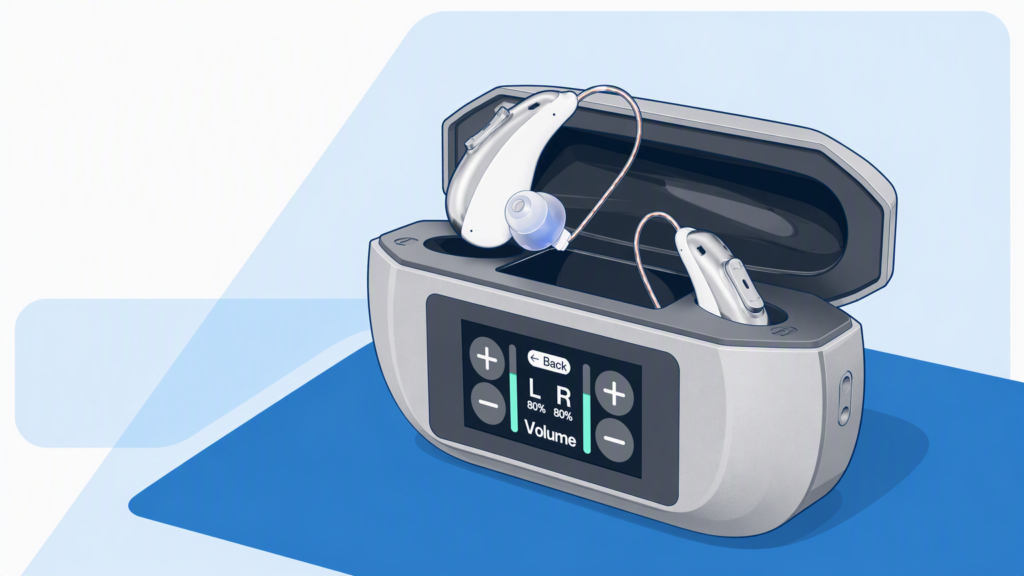
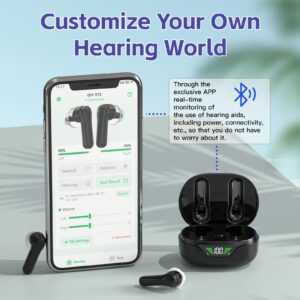
Goodmi emphasizes connection stability and ease of use: quick pairing, consistent reconnection, and intuitive app flows. Users can adjust volume, switch programs (e.g., Conversation, Outdoor, TV), and fine-tune EQ. Remote firmware updates reduce return visits and extend device utility.
2) Advanced Signal Processing for Real-World Clarity
Digital signal processing (DSP) focuses on speech enhancement, multi-band noise reduction, and adaptive feedback cancellation. Directionality options help users hear the person in front of them in cafés or meetings, a scenario that heavily influences reviews and repeat purchases.
3) Rechargeable Power, Built for Daily Routines
Rechargeable lithium solutions—often with USB-C or a dock—deliver a full day of use per charge. Select models include charging cases with battery indicators and moisture management. For retailers, this reduces support queries about coin-cell replacements and improves customer satisfaction.
4) Comfort, Discretion, and Senior-Friendly Design
Form factors range from slim BTE/RIC to discreet CIC. Lightweight shells, hypoallergenic tips, and balanced placement minimize fatigue during long wear. Physical buttons remain large and tactile for seniors, while the app serves digital-native users—covering both key demographics.
5) Certified Quality at Competitive Cost
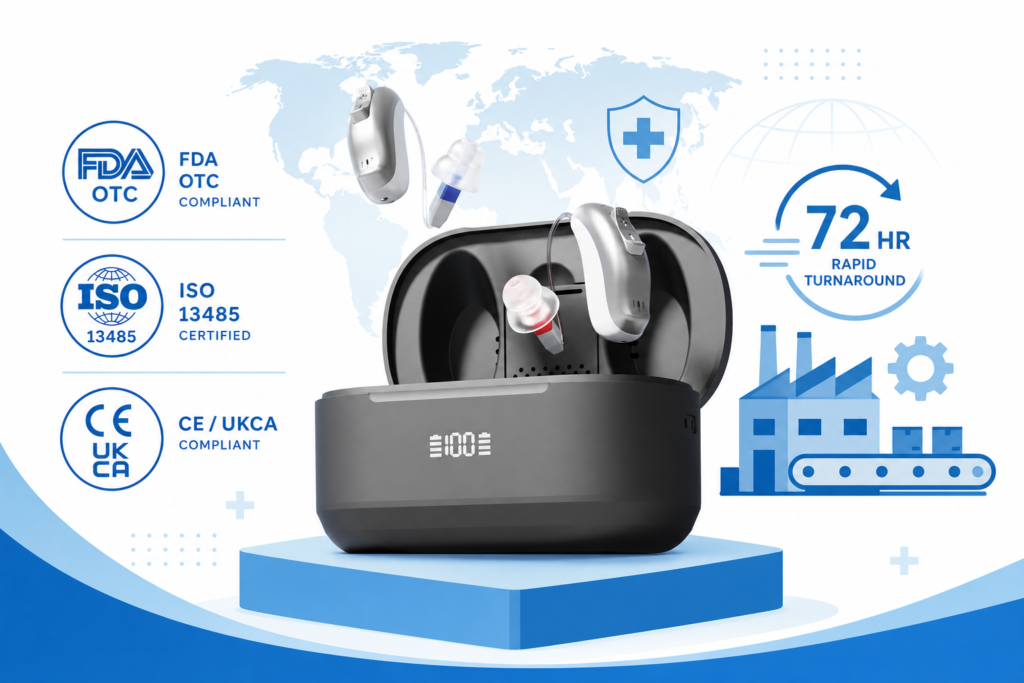
Goodmi manufactures under medical-device quality systems and supports global compliance documentation (e.g., ISO 13485, CE; FDA-readiness where applicable). For procurement teams, the combination of certified quality and value pricing makes range planning simpler and margin targets more achievable.


Feature Snapshot for Buyers
| Category | Goodmi Bluetooth Line | Buyer Impact |
|---|---|---|
| Connectivity | Bluetooth 5.x, stable pairing, low-latency media mode | Fewer returns; better NPS; cross-channel compatibility (iOS/Android) |
| Power | Rechargeable Li battery; USB-C/dock; case indicators | Lower after-sales load; improved daily adherence |
| Audio | AI noise reduction, speech focus, adaptive feedback control | Higher speech intelligibility in noise; strong user reviews |
| Form Factor | BTE/RIC/CIC options; light shells; senior-friendly controls | Broader fit coverage; reduced abandonment rates |
| App & Updates | Preset programs, EQ, OTA firmware | Longer lifecycle; fewer service visits |
| Compliance | ISO 13485 QMS; CE; documentation support | Faster market entry; smoother import checks |
Distributor & Retailer Advantages
Assortment Built for Sell-Through
Goodmi’s assortment strategy balances hero SKUs (high-demand features at mid price), step-up models (premium DSP or extra mics), and discreet variants (CIC for style-driven buyers). Clear segmentation simplifies merchandising online and in-store.
OEM/ODM Customization
Private-label partners can tailor branding, acoustics, firmware presets, packaging, and inserts. This is critical when local languages, fitting profiles, or retailer-exclusive bundles are required. Documentation kits (spec sheets, test reports) streamline onboarding.
Production Capacity & Lead Time
With scaled assembly and QA checkpoints, Goodmi supports seasonal peaks while maintaining consistency. Lead-time tiers (e.g., stock, semi-custom, full ODM) give planners flexibility on demand volatility and campaign timing.
User Experience: Where Goodmi Wins Loyalty
- Call & Media Clarity: Dual-mic directionality and speech focus elevate conversations and video calls.
- All-day Wearability: Light shells and balanced ergonomics reduce fatigue for seniors.
- App Simplicity: Intuitive controls, low learning curve, and visual battery prompts.
- Tinnitus Options (select models): Sound therapy libraries for users needing relief.
- Hygiene Aids (select kits): Drying/cleaning accessories or UV features in charging bases.
Risk Management for Procurement Teams
Documentation & Compliance
Goodmi provides certificates, test results, and labeling guidance to help pass local market checks. Batch traceability supports audits and warranty workflows.
After-Sales & Training
Guides, quick-start leaflets, and retail training assets reduce returns. For e-commerce partners, FAQ scripts and troubleshooting trees lower support tickets and protect ratings.
Looking Ahead: The Market Trajectory
Bluetooth hearing aids will keep converging with mainstream consumer audio and digital health. Expect deeper app analytics, enhanced self-fitting, and broader integrations (smart TVs, voice assistants, and telehealth portals). Goodmi’s roadmap aligns with these shifts—prioritizing reliable connectivity, user-centric DSP, and service-light ownership that retailers can scale.
Goodmi’s Bluetooth hearing aids are popular because they deliver the combination that matters most to the market: stable connectivity, clear speech in noise, all-day power, comfortable designs, certified quality, and distributor-friendly operations. For procurement leaders, that translates into higher sell-through, fewer returns, and a safer path to category growth.