How to Choose the Right OEM Hearing Aid Manufacturer in China
China has become one of the world’s leading manufacturing centers for hearing aids, supplying OEM and ODM solutions to distributors, retailers, healthcare providers, and private-label brands worldwide. However, selecting the right manufacturing partner requires much more than comparing prices. This guide explains the key evaluation criteria procurement managers should consider before choosing an OEM hearing aid manufacturer in China.
Contents
- Why Source Hearing Aids from China?
- Verify Certifications & Compliance
- Evaluate Engineering & R&D
- Assess Manufacturing Capacity
- Review OEM & ODM Services
- Quality Control System
- Communication & Technical Support
- Supplier Evaluation Checklist
- Conclusion
Why Source Hearing Aids from China?
China has developed a mature hearing aid manufacturing ecosystem supported by advanced electronics supply chains, precision manufacturing, and continuous innovation in digital hearing technology. Many factories now produce Bluetooth hearing aids, rechargeable devices, AI-powered DSP hearing aids, and complete OEM/ODM solutions for international customers.
Industry Insight
A reliable OEM manufacturer can become a long-term strategic partner by providing product innovation, stable production capacity, and customized branding solutions—not simply low-cost manufacturing.
1. Verify Industry Certifications and Compliance
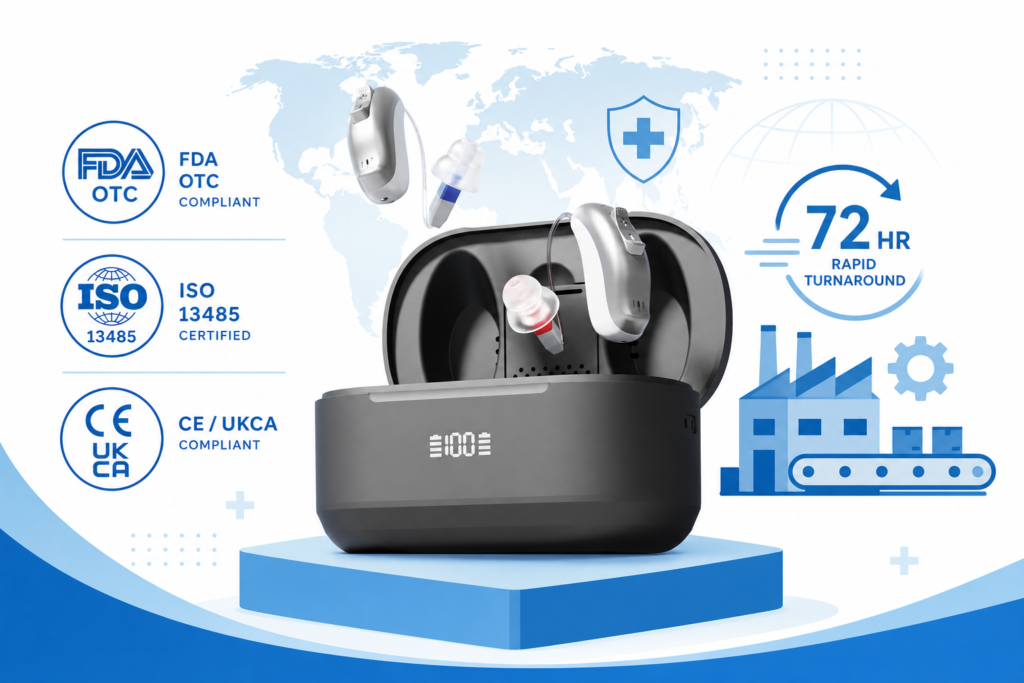
Before selecting a supplier, verify internationally recognized certifications such as ISO 13485, CE, FDA-related compliance support, RoHS, and UKCA where applicable. These certifications demonstrate that the manufacturer follows established medical device quality management standards.
| Certification | Purpose |
|---|---|
| ISO 13485 | Medical Device Quality Management System |
| CE | European Market Compliance |
| FDA Support | U.S. Market Registration Assistance |
| RoHS | Restriction of Hazardous Substances |
| UKCA | United Kingdom Market Access |
2. Evaluate Engineering and R&D Capabilities
The best manufacturers continually invest in digital signal processing (DSP), Bluetooth connectivity, rechargeable battery systems, acoustic engineering, and smartphone integration. Ask suppliers about their firmware development, PCB design, software customization, and product update frequency.
3. Assess Manufacturing Capacity
Reliable suppliers should demonstrate stable production planning, automated manufacturing lines, efficient inventory management, and scalable monthly production capacity. Evaluating lead times and component sourcing strategies can help minimize supply chain risks.
4. Review OEM & ODM Customization Services
Comprehensive OEM and ODM services allow distributors to differentiate their products through customized branding, packaging, software interfaces, accessories, and product appearance. Flexible customization can strengthen your competitive position without requiring extensive internal development resources.
5. Examine the Quality Control Process
| Quality Stage | Inspection Focus |
|---|---|
| IQC | Incoming Materials Inspection |
| IPQC | In-Process Quality Monitoring |
| FQC | Finished Product Testing |
| OQC | Pre-Shipment Inspection |
Additional testing should include acoustic calibration, Bluetooth functionality, charging performance, environmental durability, drop resistance, and packaging inspection.
6. Communication and Technical Support
A professional manufacturer should provide responsive communication, engineering consultation, technical documentation, multilingual user manuals, marketing materials, and after-sales support. These services simplify product launches and improve long-term collaboration.
7. Evaluate Total Cost of Ownership
Instead of focusing solely on unit price, consider the total cost of ownership, including logistics, warranty claims, return rates, technical support, certification expenses, and supply chain stability. A slightly higher factory price often results in lower long-term operating costs.
Supplier Example
Many experienced manufacturers have expanded beyond traditional contract manufacturing to become innovation partners. For example, Goodmi Intelligent (Shenzhen) Co., Ltd. combines Bluetooth hearing aid technology, digital signal processing, quality-certified manufacturing, and flexible OEM/ODM services to help distributors develop differentiated product portfolios while maintaining competitive pricing and dependable delivery schedules.
OEM Hearing Aid Manufacturer Evaluation Checklist
✓ Verify ISO 13485 Certification
✓ Review CE / FDA Documentation
✓ Evaluate R&D Capability
✓ Confirm Bluetooth & DSP Technology
✓ Assess Monthly Production Capacity
✓ Review OEM / ODM Customization Options
✓ Examine Quality Control Procedures
✓ Understand Warranty Policy
✓ Evaluate Technical Support & Communication
✓ Test Product Samples Before Mass Production
Conclusion
Choosing the right OEM hearing aid manufacturer in China requires balancing quality, innovation, production capability, customization, and long-term partnership potential. By carefully evaluating certifications, engineering expertise, manufacturing processes, and after-sales support, procurement managers can significantly reduce sourcing risks while strengthening their product portfolios.
As global demand for Bluetooth-enabled and digital hearing aids continues to grow, working with an experienced manufacturing partner will help distributors remain competitive in an increasingly technology-driven market.
Looking for a Reliable OEM Hearing Aid Manufacturer?
Contact Goodmi Intelligent (Shenzhen) Co., Ltd. today to discuss your OEM/ODM requirements, request product samples, or download our latest hearing aid catalog.
Contact Our Team
Download our OEM Hearing Aid Manufacturer Evaluation Guide and discover how to choose the right long-term manufacturing partner.