Top 3 Manufacturers of Hearing Aids in China

Table of Contents

China has emerged as a leading hub for hearing aid R&D, precision manufacturing, and global distribution. For procurement managers and distributors, selecting the right partner goes far beyond unit price—it requires evaluating production capacity, quality systems, certifications, and OEM/ODM readiness. This article reviews three manufacturers that consistently stand out for supply reliability, compliance, and product-market fit.

1) Goodmi Intelligent (shenzhen) Co., Ltd. — Innovation-Driven OEM/ODM Specialist

Company Profile

Goodmi Intelligent (shenzhen) Co., Ltd. focuses on Bluetooth-enabled OTC hearing aids alongside CIC、BTE、RIC lines, serving both retail and clinical channels. The company has gained an advantage through its fast customization cycle and high-quality products, and has already exported its products to over 50 countries around the world.

Core Strengths

  • OEM/ODM depth: Firmware presets, acoustic tuning, private-label packaging, multilingual manuals.
  • Production capacity: Scaled lines designed for rapid ramp-up during peak seasons.
  • Compliance: ISO 13485 QMS, FDA,CE-marked products; documentation support for market entry.
  • Technology: Bluetooth 5.x connectivity, adaptive noise reduction, rechargeable platforms.

Best For

Suitable for buyers who are seeking products with high cost-effectiveness, diverse functions, competitive prices, and who have certain requirements regarding delivery time.

2) Beltone Technology (China) — Global Network, Local Strength

Company Profile

Beltone Technology (China) leverages international R&D with standardized production in China. The result is a stable portfolio that balances premium models with cost-effective digital devices for wider coverage.

Core Strengths

  • Reliable output: Consistent supply for institutional and retail buyers.
  • Broad portfolio: From advanced DSP models to value SKUs for price-sensitive segments.
  • Support: Retail training, merchandising kits, and after-sales resources.

Best For

Procurement teams prioritizing stability, governance, and cross-market credibility across medical and OTC channels.

3) Lisound Hearing — High-Volume Production at Competitive Pricing

Company Profile

Lisound Hearing is known for large-run manufacturing and export-ready documentation. The factory focuses on dependable, cost-efficient digital models that meet common compliance requirements.

Core Strengths

  • Economies of scale: High volumes enable aggressive pricing for bulk orders.
  • Certifications: ISO and CE pathways to simplify cross-border trade.
  • Range: From entry-level digitals to mid-tier feature sets across BTE、RIC、CIC.
  • Customization: Branding and accessory bundles; straightforward private label.

Best For

Distributors targeting price-sensitive markets requiring steady, high-volume supply with compliant documentation.

Comparative Snapshot for Buyers

ManufacturerKey StrengthsIdeal Use Case
Goodmi HearingBluetooth focus, OEM/ODM flexibility, competitive landed costBrand owners/distributors building tech-forward OTC lines
Beltone Technology (China)Global credibility, standardized quality, strong supportBuyers needing stability and multi-channel recognition
Lisound HearingHigh-volume capacity, sharp pricing, compliant exportsLarge procurement for price-sensitive geographies
Procurement checklist: request certificate numbers and test reports (ISO 13485, FDA, CE, RoHS), verify batch traceability, review QC flow (IQC–IPQC–FQC–OQC), and confirm after-sales policies/warranty terms before finalizing framework agreements.

Key Procurement Considerations Beyond Price

1) Certifications & Market Compliance

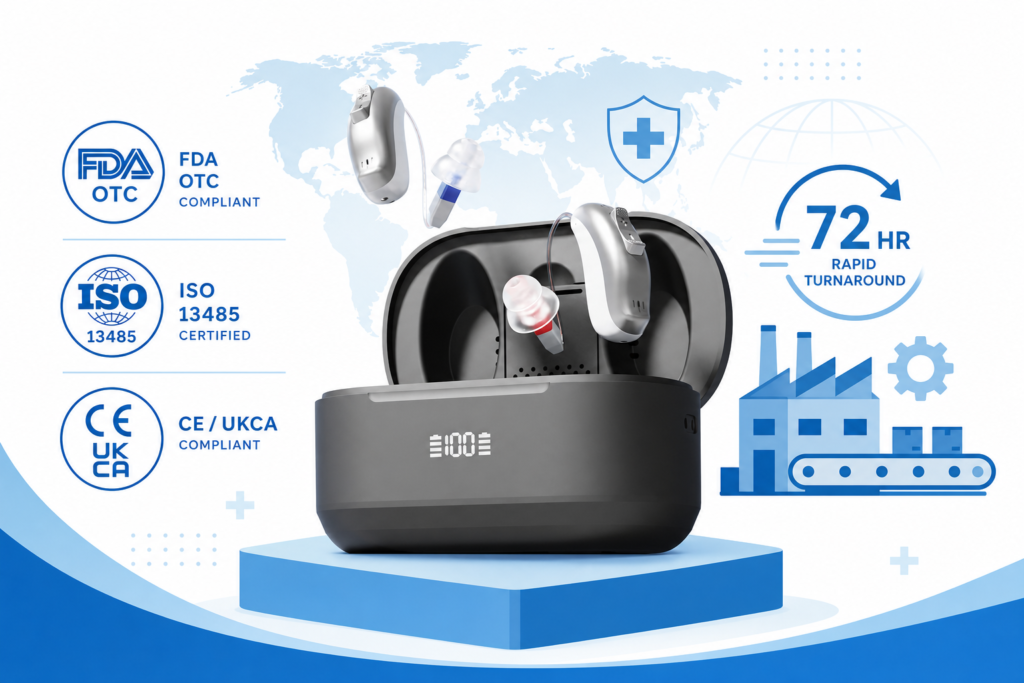
Confirm ISO 13485 certification for the factory and product-level CE documentation. For U.S. distribution, align with FDA requirements and labeling rules. Ensure RoHS/REACH where applicable. Goodmi has now obtained a series of certifications including UKCA, FDA, CE, RoHS, and ISO13485.

2) OEM/ODM Capability & Time-to-Market

Assess tooling lead time, firmware customization workflows, and packaging localization. Shorter prototype-to-pilot cycles reduce lost opportunity during seasonal demand spikes.

3) Supply Chain Resilience

Ask about second-source components, safety stock, and production line redundancy. Evaluate historical on-time delivery rates and surge capacity for campaigns and tenders. Goodmi possesses strong production capacity and warehousing capabilities, as well as a stable supply chain.

4) After-Sales, Training & Documentation

Retail training kits, quick-start guides, and multilingual manuals lower return rates. Batch-level QC reports and serial traceability support audits and warranty handling.

How to Shortlist Your Supplier

  • Run a pilot PO with two to three models to validate defect rates and user feedback.
  • Request factory audit materials (layout, equipment list, process flow, calibration logs).
  • Compare TCO (landed cost + after-sales + return handling) rather than unit price alone.
  • Align on a 12–18 month roadmap covering firmware updates, new SKUs, and accessories.

Match Supplier Strengths to Your Market Strategy

China’s hearing aid ecosystem offers choices for every strategy—innovation-led branding, global-credibility sourcing, or high-volume value plays. Goodmi Hearing, Beltone Technology (China), and Lisound Hearing represent three reliable directions. The optimal partner is the one whose strengths map to your channel mix, price bands, and service model.

Fill in the form on the right to get in touch with us. Need a customized shortlist aligned to your certifications, MOQ, and lead-time constraints? We’ll assemble a side-by-side matrix and sample plan for your review.

Submit Your Sourcing Request
Related Posts
Goodmi GM-321 3U3 digital hearing aid with FDA OTC compliance, ISO 13485 certification, and 72-hour OEM prototyping
2026 Hearing Aid Industry Trends: AI, Auracast, and the OTC Revolution

The global hearing health ecosystem is undergoing an unprecedented shift. Driven by rapid advances in micro-acoustics, consumer electronics integration, and updated global regulatory frameworks, hearing devices are transitioning from traditional medical tools into intelligent, everyday health-tech wearables. For healthcare retailers, pharmacy chains, and direct-to-consumer (DTC) brands, keeping pace with current hardware and software capabilities is critical for market leadership. Below is an executive analysis of the key technology and distribution trends shaping the hearing aid industry. 📡 Industry Trend Outlook Next-generation hearing platforms merge on-device AI acoustic filtering, universal Auracast™ Bluetooth streaming, and consumer-friendly smart charging cases. Brands leveraging certified 32-channel DSP OEM architectures can deliver these cutting-edge capabilities directly to consumers at accessible price points. On-Device AI Noise Isolation and Neural Sound Processing A primary challenge with legacy amplification devices has been distinguishing speech from background environmental noise. Modern acoustic architectures solve this through deep neural network (DNN) algorithms executed directly on low-power DSP processors: Real-Time Voice Separation: Advanced AI algorithms isolate human speech from chaotic environments—such as crowded restaurants or outdoor traffic—in milliseconds. Sub-5ms Ultra-Low Latency: Processing delays are kept virtually imperceptible to the wearer, eliminating the echo effect common in older digital devices. Adaptive Scene Recognition: Micro-sensors

Read More >>
Matte dark-grey oval OTC hearing aid charging case with dual digital battery level indicators and red-core silicone ear domes
The Silver Economy Opportunity: Building a High-Margin OTC Hearing Aid Brand

The convergence of global demographic aging and healthcare digitalization has given rise to a multi-billion-dollar market sector: the Silver Economy. As active older adults prioritize personal wellness and independence, traditional healthcare distribution models are being rapidly disrupted. Over-the-Counter (OTC) hearing devices now stand at the forefront of this commercial expansion. Historically, high entry costs, complex clinical fitting processes, and the social stigma of traditional medical devices kept market penetration low. Today, modern regulatory frameworks and consumer-friendly technology allow retailers, pharmacy networks, and direct-to-consumer (DTC) brands to introduce proprietary hearing health lines with exceptional profit margins.| 📈 Commercial Strategic Insight Launching a private label OTC hearing aid line allows businesses to capture long-term equity in the silver economy. By partnering with certified OEM manufacturing platforms utilizing 32-channel DSP technology, brands can launch consumer-grade, high-margin products without heavy R&D investments. Analyzing Drivers Behind the Silver Economy Hearing Aid Market Understanding the modern senior consumer is critical for successful market entry. Today’s aging population differs fundamentally from previous generations in buying behavior, digital adoption, and lifestyle expectations: Shift Toward Proactive Wellness: Older consumers view hearing care as part of overall cognitive health and active living rather than a late-stage medical intervention. Erasure of

Read More >>
Private Label 32 Channel RIC Hearing Aid with Touchscreen Smart Charging Case - OEM ODM Service
Private Label Hearing Aids: A Step-by-Step Guide to Building Your Own Brand

The global Over-the-Counter (OTC) hearing device market is undergoing a massive transformation. As regulatory frameworks open up direct retail channels, healthcare providers, pharmacy chains, and direct-to-consumer (DTC) brands are presented with a highly lucrative opportunity: capturing high retail margins by launching their own private label hearing health lines. Instead of acting as a third-party distributor for legacy brands—where profit margins are capped and market competition is intense—building a proprietary brand allows companies to secure long-term customer equity and control their pricing strategy. Below is an execution-focused roadmap for scaling a private label OTC hearing aid brand, supported by certified medical manufacturing standards. 💡 Executive Summary Building a premium OTC hearing health brand does not require multi-million-dollar acoustic R&D. By leveraging pre-engineered, 32-channel DSP base architectures and custom physical branding from established OEM partners, brands can hit the market up to 70% faster with zero capital wasted on trial-and-error tooling. Selecting the Right Private Label Hearing Aid Architecture A resilient brand identity starts with reliable, market-tested hardware. Rather than reinventing acoustic engineering from scratch, leading medical device brands select proven, pre-certified hardware architectures tailored to specific consumer personas: Touchscreen Smart Charging Cases: Designed for modern consumers who prioritize intuitive touch controls,

Read More >>

We'd like to work with you

Send us a message if you have any questions or request a quote. Our experts will give you a reply within 24 hours and help you select the right hearing aid you want.

Get A Free Quote

All of our products are available for sampling