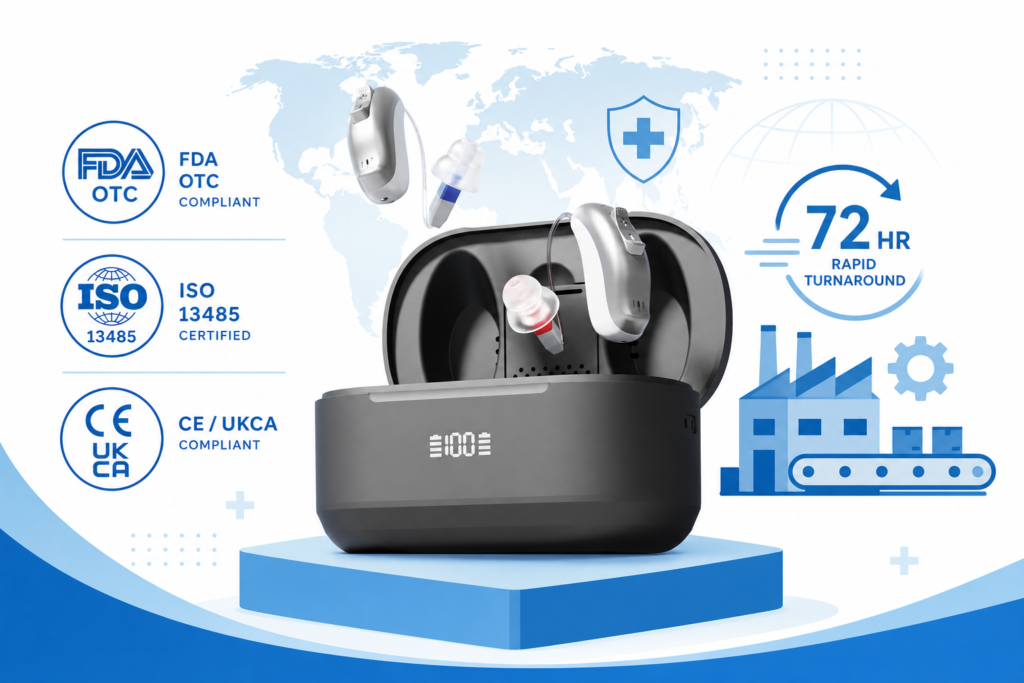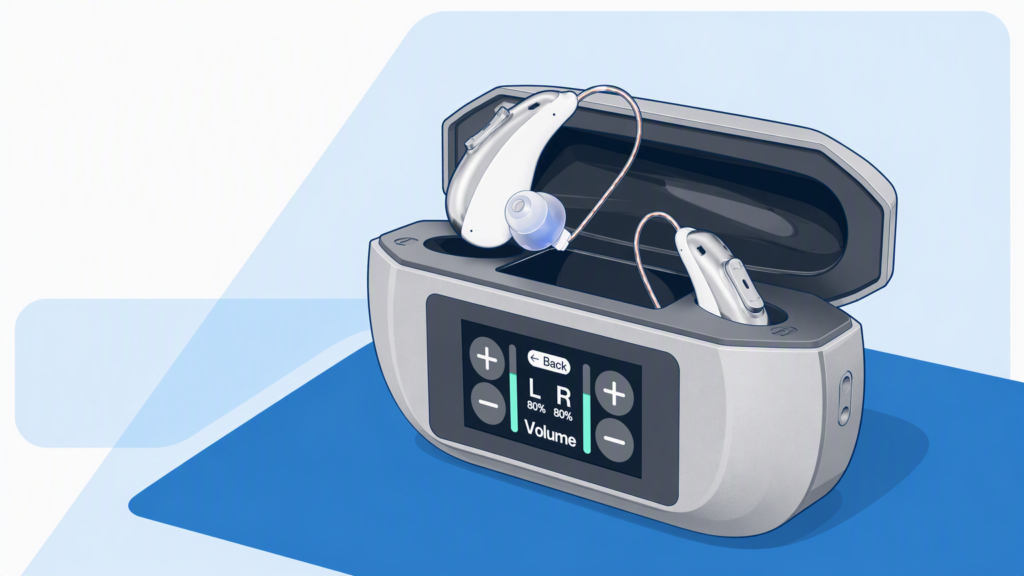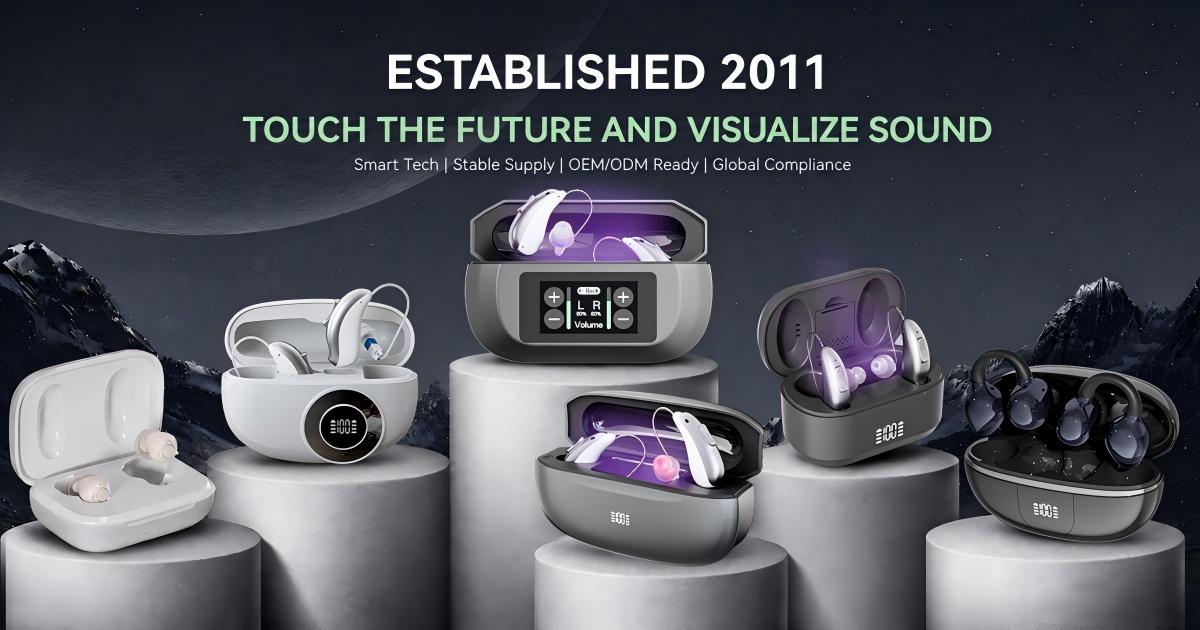
Choosing a hearing aid manufacturer for an OEM or private label project is a business decision, not just a price comparison. The right partner should be able to provide consistent product quality, appropriate regulatory documentation, clear customization boundaries, reliable production planning, and responsive support after delivery.
This guide explains how distributors, importers, hearing clinics, medical device companies, and private label brands can evaluate a hearing aid manufacturer before moving from product research to samples and bulk orders.
Key Takeaways
- Request model-specific specifications and compliance documents instead of relying only on a factory presentation.
- Evaluate samples, packaging, labeling, manuals, and after-sales support together with the device itself.
- Separate OEM, ODM, and private label requirements before requesting a quotation.
- Confirm MOQ, sample policy, lead time, production changes, inspection, warranty, and spare-parts support in writing.
- Choose a manufacturer that can support your target market and expected order growth, not only your first order.


1. Define Your OEM or Private Label Project Before Contacting Manufacturers
The first step is to define what you are actually buying. An OEM project may use an existing hearing aid platform with your brand identity, packaging, documentation, or approved configuration. A private label project usually focuses on selling an existing product under your brand. An ODM project may involve deeper product design, engineering changes, or a new product developed around your requirements.
Prepare a short project brief before contacting a manufacturer. It should include your target countries, buyer type, hearing aid style, required features, estimated order quantity, branding requirements, packaging expectations, certification needs, and target launch date.
- Target market: United States, Canada, United Kingdom, European Union, Australia, or another market.
- Customer type: distributor, wholesaler, clinic, retailer, medical device company, or online brand.
- Product type: CIC, RIC, BTE, OTC, rechargeable, Bluetooth, or another configuration.
- Branding scope: logo, housing, color, packaging, manuals, app, accessories, or product configuration.
- Commercial plan: sample quantity, expected first order, forecast, and repeat-order schedule.
 2. Check Whether the Manufacturer Has the Right Product and Engineering Capability
 2. Check Whether the Manufacturer Has the Right Product and Engineering Capability
A manufacturer may produce hearing aids but still be unsuitable for your product program. Review whether its product range, engineering team, tooling capability, firmware process, and testing resources match your project.
Ask the manufacturer to explain which parts of the product are standard and which parts can be customized. This distinction prevents a common sourcing problem: a buyer assumes a feature can be changed, but the supplier treats it as fixed because it belongs to an existing platform.
| Area to evaluate | Questions to ask |
|---|---|
| Product platform | Which hearing aid models are already in production, and which are suitable for our target market? |
| Audio configuration | Which components, processing options, programs, and user controls are standard or optional? |
| Mechanical design | Can the housing, color, buttons, charging case, or accessories be changed? |
| Software and firmware | How are firmware changes tested, approved, documented, and released? |
| Documentation | Can the supplier provide specifications, labeling files, manuals, packaging artwork, and test documents? |
 3. Verify Quality Management and Market-Specific Compliance
 3. Verify Quality Management and Market-Specific Compliance
Quality and regulatory documentation should be checked at the product and target-market level. A general factory certificate does not automatically prove that every hearing aid model, label, claim, or configuration is approved for every country.
For a United States project, ask which entity is responsible for the device, manufacturing, registration, listing, complaint handling, and post-market obligations. The U.S. Food and Drug Administration explains that its Quality Management System Regulation applies to finished device manufacturers intending to commercially distribute medical devices. Review the current requirements with your regulatory adviser and the responsible market entity.
For an EU project, ask how the product is classified, which conformity assessment route applies, who is the legal manufacturer, whether an EU Authorised Representative is required, and which technical documentation and labeling obligations apply. The European Commission medical devices guidance is a useful starting point, but it does not replace professional regulatory advice.
Documents to request
- Model-specific product specification or datasheet
- Applicable quality management certificates
- Target-market conformity or regulatory documentation, where applicable
- Test reports supporting published performance claims
- Labeling, user manual, packaging, and traceability information
- Declaration or responsible-party information required for the target market
- Complaint, warranty, recall, and corrective-action procedures
Do not publish FDA, CE, MDR, ISO, or other certification claims on a product page until the document scope, issuing body, validity period, legal entity, product model, and destination market have been checked.
4. Evaluate Samples, Not Only Catalog Images
 4. Evaluate Samples, Not Only Catalog Images
A sample evaluation should test whether the product, packaging, documents, and communication process match the commercial promise. Catalog images show positioning; samples reveal execution.
- Confirm that the sample matches the quoted model and configuration.
- Check physical finish, fit, charging contacts, controls, indicators, and accessories.
- Review the user manual, labels, packaging, and language quality.
- Test the product under the use cases relevant to your customer segment.
- Record defects, requested changes, and acceptance criteria in a sample approval document.
- Confirm that the approved sample is the reference for bulk production.
For hearing aid products, evaluation should be performed according to the applicable professional, fitting, labeling, and market requirements. Avoid treating a short demonstration as proof of clinical suitability or universal hearing performance.
5. Compare OEM, ODM, and Private Label Scope Clearly
OEM, ODM, and private label are often used interchangeably in sales conversations, but they can involve different responsibilities, costs, timelines, intellectual property arrangements, and approval processes.
| Project type | Typical scope | Best suited for | Key questions |
|---|---|---|---|
| Private label | Existing product sold under a buyer’s brand, often with packaging and documentation changes. | Brands testing a market or expanding a product range. | What is standard, and what branding elements are included? |
| OEM | Existing platform produced to agreed branding, configuration, packaging, and documentation requirements. | Distributors and established brands with defined product requirements. | Which specifications and changes are contractually approved? |
| ODM | Broader product development involving design, engineering, validation, and production. | Companies seeking differentiated products or new product platforms. | Who owns the design, tooling, firmware, data, and market documentation? |
Before signing, ask the manufacturer to separate one-time engineering costs, tooling, sample charges, packaging costs, unit prices, testing costs, and recurring production costs.
 6. Review MOQ, Pricing, Lead Time, and Production Scalability
 6. Review MOQ, Pricing, Lead Time, and Production Scalability
The lowest unit price is not always the lowest total sourcing cost. A realistic evaluation should include MOQ, sample fees, tooling, packaging, testing, shipping, payment terms, inspection, rework, warranty, and the cost of future changes.
Commercial questions for a manufacturer
- What is the MOQ for standard products, private label, OEM, and ODM projects?
- Is the MOQ calculated per model, color, packaging design, or order?
- What is the sample process and how are sample charges handled?
- What is the expected lead time for samples and approved bulk production?
- What events can change the lead time?
- How are urgent orders, component shortages, and production changes communicated?
- Can the manufacturer support repeat orders and higher volumes?
Request a written quotation with an expiry date and a clear description of what is included. Do not compare quotations until model, configuration, packaging, documentation, testing, Incoterms, and payment terms are aligned.
7. Check Quality Control, Inspection, and Change Management
A dependable manufacturer should be able to explain how quality is controlled before, during, and after production. Ask whether incoming components, assembly, calibration, charging performance, labeling, packaging, and final inspection are recorded.
For an OEM or private label project, change management is especially important. A component substitution, firmware update, packaging change, or supplier change can affect product performance, documentation, and regulatory obligations.
Minimum quality questions
- Which inspections are completed before shipment?
- What acceptance criteria are used for the approved sample?
- How are non-conforming products recorded and corrected?
- How are component, firmware, packaging, and labeling changes approved?
- Can the supplier provide batch or lot traceability?
- What happens if the delivered products do not meet the agreed specification?
8. Evaluate Communication and After-Sales Support
Hearing aid distribution requires more than a shipment. Your team may need product training, user manuals, troubleshooting guidance, spare parts, warranty processing, replacement procedures, and support for customer complaints.
Before placing a bulk order, identify the people responsible for sales communication, engineering questions, quality issues, documents, and after-sales service. Confirm the expected response process and escalation path in writing.
| Support area | What to confirm |
|---|---|
| Technical support | Product setup, troubleshooting, firmware, accessories, and manuals. |
| Warranty | Coverage period, defect definition, evidence required, repair, replacement, and shipping responsibility. |
| Spare parts | Availability, pricing, replacement process, and expected support period. |
| Complaints | How product complaints are recorded, investigated, escalated, and closed. |
9. Use a Manufacturer Evaluation Scorecard
Use a scorecard instead of choosing a supplier based on one attractive feature or the lowest quotation. Score each manufacturer using the same evidence requirements.
| Evaluation area | Suggested weight | Evidence to review |
|---|---|---|
| Product and engineering fit | 20% | Samples, specifications, customization scope, engineering response. |
| Quality and compliance | 25% | Quality certificates, model documents, test reports, traceability, audit answers. |
| OEM / ODM capability | 15% | Past project process, branding, packaging, tooling, design, and change control. |
| Production and supply continuity | 15% | Capacity evidence, component planning, lead-time communication, repeat-order process. |
| Commercial terms | 10% | MOQ, quotation scope, payment terms, shipping terms, and cost transparency. |
| Support and communication | 15% | Response process, training, warranty, spare parts, and complaint handling. |
A manufacturer that refuses to provide basic evidence should receive a lower score, even if its initial price is attractive. Evidence quality is part of supplier quality.
10. Questions to Ask Before Signing a Supply Agreement
- Which legal entity will manufacture, invoice, and provide product documentation?
- Which exact model and configuration are included in the quotation?
- Which product claims are supported by current test reports?
- Which documents apply to our target market and product model?
- What is included in the OEM or private label scope?
- Who owns the artwork, tooling, firmware changes, designs, and project data?
- What is the MOQ for each model, color, package, and configuration?
- What is the sample approval and bulk production process?
- How are quality issues, recalls, complaints, and corrective actions handled?
- What warranty, spare-parts, and after-sales support will be provided?
Goodmi OEM and Private Label Project Support
Goodmi Intelligent (Shenzhen) Co., Ltd. presents OEM and ODM services for hearing aid distributors, importers, clinics, and private label brands. The available project scope should be confirmed according to the product model, target market, documentation requirements, branding needs, MOQ, and production plan.
Explore the Goodmi OEM and ODM service page to review the cooperation process, or visit the company capability page and certifications page as part of your supplier evaluation.
For a project review, send your target market, expected order quantity, product type, branding requirements, packaging needs, certification expectations, and desired timeline through the Goodmi contact page.
Request an OEM or Private Label Hearing Aid Evaluation
Tell us about your market, product requirements, estimated quantity, and branding plan. Goodmi can review the project scope and confirm the applicable sample, MOQ, customization, documentation, and quotation process.
Frequently Asked Questions
What is the difference between OEM and private label hearing aids?
Private label usually means selling an existing product under your brand, often with packaging or documentation changes. OEM may include agreed product configuration and branding requirements. The exact scope depends on the supplier’s project definition and the written agreement.
What should I request from a hearing aid manufacturer?
Request model-specific specifications, samples, applicable quality and regulatory documents, labeling and manual files, quotation terms, MOQ, lead time, inspection details, warranty terms, spare-parts support, and complaint-handling procedures.
How do I compare hearing aid manufacturers?
Compare manufacturers using the same scorecard for product fit, evidence-based quality, compliance, OEM or ODM capability, production continuity, commercial terms, communication, and after-sales support. Do not compare unit price without aligning model configuration and included services.
Can a hearing aid manufacturer provide certification documents?
A manufacturer should be able to explain which documents apply to the product model, legal manufacturer, and target market. Buyers should verify document scope and validity independently and obtain professional regulatory advice before placing a market-specific order.
What information should I include in an OEM hearing aid inquiry?
Include your target country or region, buyer type, hearing aid style, required features, estimated quantity, branding and packaging requirements, certification expectations, sample needs, and target launch date. This helps the manufacturer provide a more accurate project review.
References
- U.S. Food and Drug Administration: Quality Management System Regulation (QMSR)
- European Commission: Medical devices – new regulations
- European Commission: MDCG endorsed documents and guidance
Last reviewed: August 2026. Regulatory requirements can change. Always verify current requirements with the relevant authority or a qualified regulatory professional before commercial distribution.