The Over-the-Counter (OTC) hearing aid market continues to grow, while distributors, private-label brands, and e-commerce sellers face a familiar challenge: many products look and operate in very similar ways. In a crowded category, buyers need features that are easy for end users to understand and meaningful enough to support product differentiation.
One increasingly relevant direction in 2026 is the combination of a touchscreen charging case and a mobile companion app. Unlike a display-only case, a touchscreen case can provide direct access to supported controls as well as status information, while an OTC hearing aid with app control can offer deeper adjustment and personalization.
Why Usability Differentiation Matters in OTC Hearing Aids
OTC hearing aid users have different levels of comfort with technology. Some prefer quick, direct controls, while others value the flexibility of smartphone-based adjustment. A product that depends entirely on one control method may not fit every user equally well.
For B2B brands, usability is therefore more than a consumer-experience issue. Clearer controls, visible device status, and easier adjustment can help reduce setup confusion, routine support questions, and avoidable user errors. The goal is not to add complexity—it is to make important functions easier to access.
The Value of Touchscreen Case + App Dual Control
1. Direct Touchscreen Control for Everyday Use
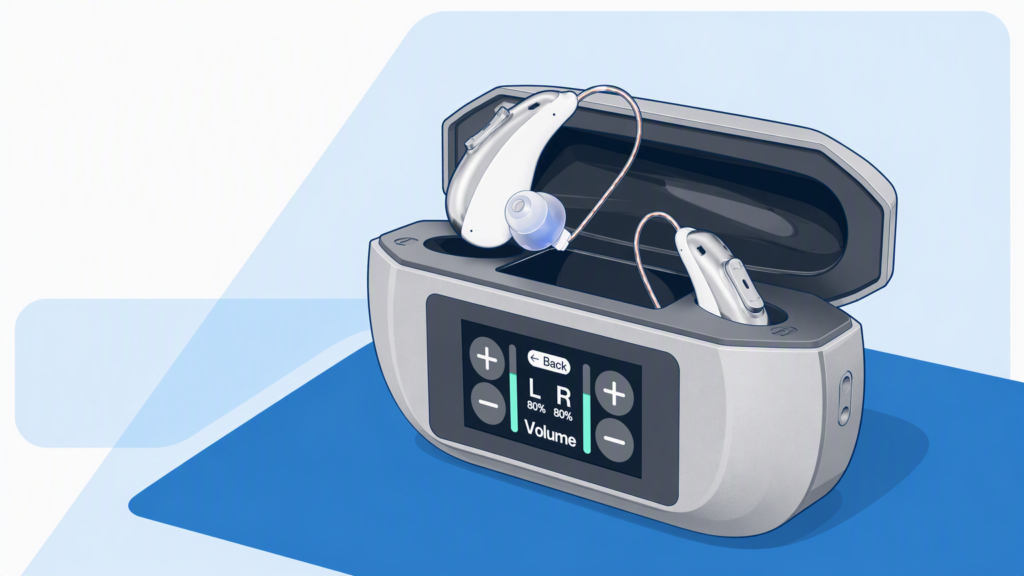
A touchscreen charging case allows users to interact with supported functions directly from the case instead of relying on a smartphone for every action. The screen can also provide clear visual feedback such as charging, battery, mode, or other device-status information depending on the model.
This makes common daily interactions more immediate and can be especially useful for users who want a simple, visible interface without opening an app each time.
2. Deeper Adjustment Through the Mobile App
For users who want more detailed control, the companion app can provide access to supported sound settings such as volume, listening modes, EQ or frequency-related adjustment, and noise-management functions. Available functions vary by model, so B2B buyers should confirm the exact app capabilities before sourcing.
3. A More Flexible User Experience
The value of dual control is not simply having two interfaces. It is giving users two levels of interaction: fast and intuitive operation through the touchscreen case, plus deeper personalization through the app. This can broaden product appeal across different user preferences and usage habits.
4. Potential to Reduce Avoidable Support Issues and Returns
When users can clearly see device status and access supported controls more easily, they may be less likely to mistake charging, setup, or operating issues for product failure. While return performance depends on many factors, better usability can help address some user-related causes of dissatisfaction.
What B2B Buyers Should Verify Before Sourcing
When evaluating a smart hearing aid manufacturer for a private-label or distribution project, review the specifications and documentation for the exact model and target market—not only the headline features.
- Touchscreen Functions: Confirm exactly what can be controlled from the charging case and what information the screen displays.
- App Functions: Verify supported adjustment options, operating systems, languages, pairing flow, and whether app branding or UI customization is available.
- Sound Processing: Confirm the number of processing channels, listening modes, noise-management functions, gain/output specifications, and other acoustic parameters for the specific model.
- Form Factor & Comfort: Choose a design that matches your target customer, such as RIC, CIC, BTE, or other rechargeable formats, and review fitting comfort and accessory options.
- Charging System: Review battery life, charging time, magnetic-contact design, case capacity, and the screen or touchscreen behavior during charging.
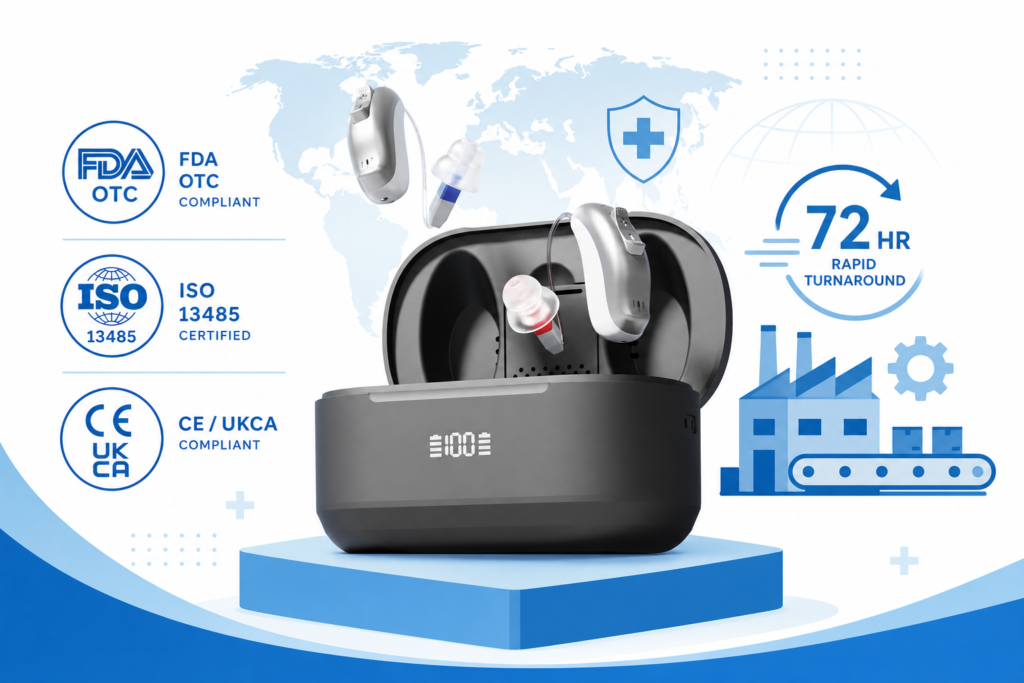
- Compliance & Documentation: Confirm the certifications, test reports, quality-system documents, labeling requirements, and market-specific compliance materials available for the selected model.
- OEM/ODM Capability: Review branding, packaging, color, app-related customization, sampling, MOQ, lead time, and after-sales support before launch.
Partnering with Goodmi: OEM/ODM Support for Smart Hearing Aids
Goodmi Intelligent (Shenzhen) Co., Ltd. provides hearing aid OEM/ODM support for global B2B customers. With 14 years of acoustic engineering experience, a 3,000 sqm SGS-verified factory, and monthly production capacity of up to 100,000 units, Goodmi supports distributors, retailers, e-commerce sellers, and private-label brands across multiple markets.
For buyers looking for more differentiated products, selected Goodmi models combine touchscreen charging case control with app-based sound adjustment, together with multi-channel digital processing and other model-specific sound features. Available functions, acoustic specifications, and compliance documentation should be confirmed for each model and destination market.
| OEM/ODM Area | Typical Support |
|---|---|
| Branding | Private-label logo and product branding for supported projects |
| Packaging | Customized packaging, manuals, labels, and presentation materials |
| Appearance | Selected color and exterior customization options |
| App-related support | Available app branding or UI-related options depending on project scope |
| Sampling & project support | Model selection, specification confirmation, sample preparation, and launch coordination |
Frequently Asked Questions (FAQ)
What does “dual control” mean in a hearing aid?
In this context, dual control means the hearing aid system can be operated through both a touchscreen charging case and a mobile app. The touchscreen case supports direct access to selected functions and status information, while the app provides additional adjustment options depending on the model.
What is the advantage of a touchscreen charging case?
A touchscreen case does more than show battery information. It can give users a direct, visible way to access supported controls without opening a smartphone app, helping make everyday operation more intuitive.
Does every Goodmi model have the same touchscreen and app functions?
No. Functions vary by model. Buyers should confirm the exact touchscreen controls, app settings, acoustic specifications, and available customization before placing an OEM/ODM order.
Can Goodmi customize the app UI and packaging for OEM clients?
Goodmi offers OEM/ODM customization for supported projects, including branding, packaging, color options, and selected app-related customization. The available scope depends on the model, order quantity, and project requirements.
What compliance documents are available?
Documentation depends on the selected model and destination market. B2B buyers should confirm the applicable certifications, test reports, labeling requirements, and quality-system documentation during project evaluation.
Explore Touchscreen + App Hearing Aid OEM/ODM Options
Looking for a differentiated OTC hearing aid solution for your private-label lineup? Contact Goodmi’s B2B team for model specifications, touchscreen and app functions, customization options, sampling support, and an OEM/ODM quotation.